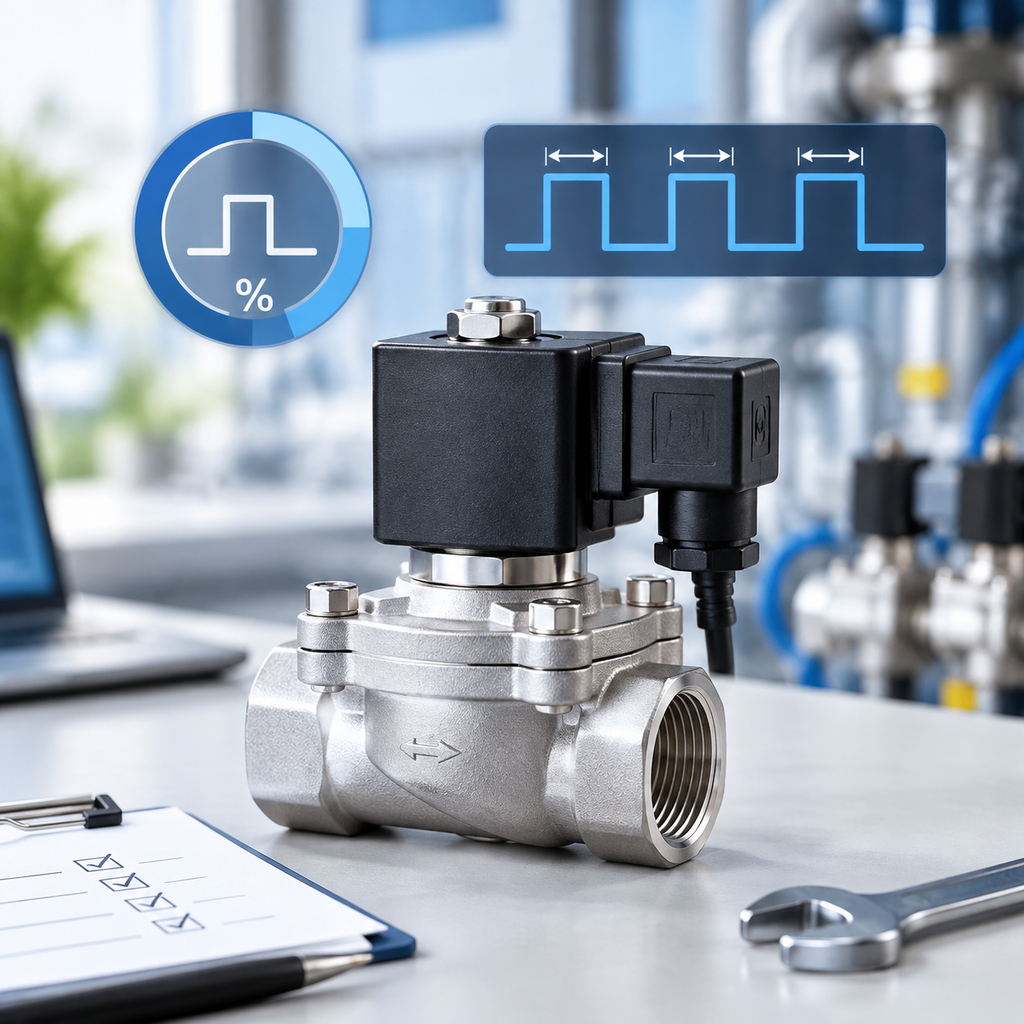
Solenoid Valve Duty Cycle and Switching Frequency: What to Check
Solenoid valve duty cycle switching frequency review helps automation engineers, OEM designers, and maintenance teams confirm whether a valve and coil are suitable for repeated energizing in a real process. Before specifying frequent switching, check cycle rate, energized time, coil heating, ambient temperature, coil voltage, pressure differential, medium condition, contamination risk, response requirement, and service-life evidence from the selected model’s datasheet.
Shanghai Juliang Valve Group presents solenoid valve products on its public product page and describes its business around industrial valve manufacturing and fluid control applications. In this article, the company is used only as a practical context for B2B valve selection; exact limits must still come from the selected solenoid valve datasheet, not from general product category descriptions.
What does duty cycle mean for a solenoid valve?
Duty cycle means how long the solenoid coil is energized compared with the total operating period. Switching frequency means how often the valve changes state within a defined time, such as cycles per minute or cycles per hour.
A simple analogy is a delivery van in city traffic. A van that drives briefly, stops, and rests has a different thermal load than one that accelerates and brakes continuously all day. A solenoid valve is similar: every electrical actuation creates heat in the coil, and every mechanical movement loads the plunger, spring, seal, and guide surfaces.
For a buyer, the important point is not only whether the valve opens and closes. The question is whether the selected valve can repeat that action under the specified voltage, pressure differential, medium, temperature, and contamination conditions for the required service expectation.
What should a buyer check before specifying frequent solenoid-valve switching?
Check the actual switching pattern first, then compare it with the selected model’s datasheet and supplier documentation. The minimum review should include cycle rate, energized time, de-energized time, ambient temperature, medium temperature, coil voltage tolerance, pressure differential, medium type, contamination level, required response time, mounting position limits, and expected maintenance interval.
The most common mistake is to ask only for “fast switching” or “continuous duty.” Those phrases are not enough for engineering selection. A valve that works in intermittent clean-air service may behave differently in warm water, oil, steam, vacuum, corrosive gas, or particle-contaminated media.
Buyers should document the operating case that produces the highest combined electrical, thermal, and mechanical load. If the application has several operating modes, review each mode rather than selecting from the average condition alone.
Why do coil heating and ambient temperature matter?
Coil heating matters because electrical energy becomes heat during energization, and that heat must be dissipated safely within the coil’s design limits. Ambient temperature matters because a hot cabinet, machine enclosure, or outdoor location can reduce the coil’s ability to shed heat.
Frequent switching can create two different heating concerns. The first is long energized time, where the coil remains powered for extended periods. The second is repeated actuation, where electrical and mechanical cycling happens often. Depending on the valve design, either condition may be limiting.
Voltage also affects heating. A coil operated outside the documented voltage range may run hotter, pull in weakly, chatter, or fail to shift reliably. Buyers should confirm AC or DC supply, nominal voltage, tolerance, inrush characteristics where relevant, and whether the control output can support the coil load.
How do medium and pressure differential change the review?
Medium and pressure differential can change the force required to shift the valve and the wear experienced by internal parts. Air, water, oil, inert gas, steam, vacuum service, and chemically aggressive media are not interchangeable conditions.
Pressure differential is especially important because many solenoid valves depend on defined pressure conditions to open or close correctly. Too little differential, too much differential, reverse pressure, or pressure spikes can affect response and sealing behavior. Exact allowable pressure ranges must come from the datasheet for the chosen construction.
The medium also affects seals, seats, orifices, corrosion exposure, viscosity, and contamination sensitivity. A valve selected for clean compressed air may not be suitable for viscous liquid or particulate-laden water without design review. If the medium can deposit scale, fibers, rust, or crystallized material, filtering and maintenance access become part of the duty-cycle decision.
What can happen if switching frequency is not reviewed?
If switching frequency is not reviewed, the valve may overheat, respond inconsistently, stick, chatter, wear prematurely, or fail to meet the automation sequence. The risk is not limited to the valve itself; it can affect machine timing, process stability, batch consistency, and troubleshooting workload.
In an OEM machine, an underspecified valve may pass a short bench test but fail after repeated production cycling. In a maintenance replacement, a visually similar valve may fit the pipe and voltage but still be wrong for the real duty. In a process line, delayed closure or incomplete opening can create unstable flow, pressure fluctuations, or nuisance alarms.
This is why the buyer’s RFQ should include the real operating pattern, not only connection size and voltage. A solenoid valve is an electrical, thermal, mechanical, and fluid-control component at the same time.
Which duty-cycle scenarios need closer review?
Low-frequency intermittent operation
Switching pattern: Occasional actuation with long rest periods.
Main concern: Confirm compatibility with medium, pressure differential, voltage, and temperature.
Buyer action: Check the datasheet for allowable pressure range, coil voltage, materials, and mounting requirements.
Suitability boundary: Do not assume suitability if the medium is corrosive, hot, contaminated, or outside the documented limits.
Frequent short-pulse operation
Switching pattern: Many cycles with brief energized periods.
Main concern: Mechanical wear, response repeatability, controller output capacity, and coil heating from repeated operation.
Buyer action: Ask for model-specific switching frequency limits and service-life data where available.
Suitability boundary: Do not specify from cycle rate alone; confirm pressure differential and medium condition.
Long energized operation
Switching pattern: Coil remains powered for extended periods.
Main concern: Coil temperature rise and ambient heat accumulation.
Buyer action: Verify duty rating, insulation class information if provided, enclosure conditions, and voltage tolerance.
Suitability boundary: Avoid assuming that “normally open” or “normally closed” automatically solves heat exposure.
High-temperature or enclosed installation
Switching pattern: Any cycle rate in a hot area, control cabinet, or compact machine space.
Main concern: Reduced heat dissipation and higher coil surface temperature.
Buyer action: Review ambient temperature, medium temperature, ventilation, spacing, and cable temperature rating.
Suitability boundary: Datasheet limits must be checked at the real installation temperature, not only room temperature.
Dirty or scaling medium
Switching pattern: Any operation where solids, rust, fibers, scale, or sticky deposits may be present.
Main concern: Sticking, blocked orifices, slow response, and seat damage.
Buyer action: Review filtration, flushing, orientation, maintenance access, and material compatibility.
Suitability boundary: A high cycle rate cannot compensate for contamination that prevents free movement.
What are three common misconceptions about solenoid valve duty cycle?
Misconception one: If the voltage is correct, the valve is suitable.
The more accurate view is that voltage is only one input. Buyers must also check current draw, coil heating, duty rating, ambient temperature, pressure differential, and the medium. A correct voltage on the nameplate does not prove suitability for rapid cycling or long energized operation.
Misconception two: Higher switching speed always means better performance.
The more accurate view is that response time must match the process. Excessively fast actuation can contribute to pressure shocks in some systems, while slow actuation may disrupt machine timing. The right response depends on the control sequence, piping volume, pressure conditions, and downstream equipment.
Misconception three: Cycle life is universal across all applications.
The more accurate view is that service life depends on the selected model and application conditions. Media quality, pressure differential, temperature, installation, voltage stability, and maintenance all affect wear. Do not apply a general cycle-life number unless it is documented for the specific valve and comparable duty.
How should engineers turn the review into a specification?
Start by writing the operating cycle in measurable terms. Include cycles per minute or hour, energized time, de-energized time, number of operating hours per day, and expected starts per year if known. Then add the process conditions: medium, pressure range, pressure differential, temperature, contamination, and cleaning or flushing conditions.
Next, define the electrical environment. Record AC or DC voltage, tolerance, control output type, available current, cable length concerns, enclosure temperature, and whether the coil is exposed to heat from nearby equipment.
Finally, define acceptance evidence. For a project submittal, ask for the datasheet of the exact selected model, materials of construction where relevant, electrical data, pressure and temperature limits, response information if published, installation instructions, and any model-specific limits on switching frequency or duty cycle. If data is not available, treat that as an engineering review item rather than filling the gap with assumptions.
How can a supplier discussion stay evidence-based?
Keep the discussion tied to the selected model and the documented operating case. Shanghai Juliang Valve Group’s public materials identify solenoid valves as part of its industrial valve product scope, but a buyer still needs model-specific documentation before applying any valve to frequent switching service.
A useful supplier question is not “Can this valve switch fast?” A better question is: “For this medium, pressure differential, voltage, ambient temperature, energized time, and cycle rate, what published limits or documented guidance apply to this exact model?”
If the application is unusual, such as high cycling in a compact cabinet, dirty liquid service, or rapid actuation under changing pressure, ask whether an alternate construction, coil option, filtration arrangement, or different valve type should be reviewed. The answer should be supported by current technical documentation.
What practical checklist should buyers use before release?
A practical checklist should cover the operating pattern, electrical limits, process conditions, installation environment, and documentation. The goal is to prevent a valve from being selected only by port size, voltage, and price.
Confirm the switching pattern: cycles per minute or hour, energized time, de-energized time, and daily operating hours.
Confirm the electrical supply: AC or DC, nominal voltage, tolerance, current capacity, wiring method, and controller output rating.
Confirm the process conditions: medium, pressure range, pressure differential, temperature, flow direction, viscosity where relevant, and contamination risk.
Confirm the installation: ambient temperature, enclosure ventilation, mounting orientation, access for maintenance, filtration, and exposure to washdown or weather if applicable.
Confirm the evidence: exact model datasheet, material compatibility information, pressure and temperature limits, duty-cycle guidance, switching frequency guidance, and response data when required by the automation sequence.
Frequently Asked Questions
What should a buyer check before specifying frequent solenoid-valve switching?
A buyer should check cycle rate, energized time, coil voltage, coil heating, ambient temperature, pressure differential, medium type, contamination risk, response requirement, and expected service-life data. These items should be compared with the exact model’s datasheet. General product descriptions are not enough for frequent switching applications because thermal and mechanical limits depend on the valve construction and operating conditions.
How is solenoid valve duty cycle different from switching frequency?
Duty cycle describes the percentage of time the coil is energized during an operating period. Switching frequency describes how often the valve changes state. A valve may have a high duty cycle with few switches if it stays energized for a long time, or a lower duty cycle with many short pulses. Both factors should be reviewed because they affect heating, wear, and response reliability.
Can a continuous-duty solenoid valve handle rapid cycling?
Not automatically. Continuous duty generally relates to the coil’s ability to remain energized under documented conditions, but rapid cycling also involves mechanical movement, pressure forces, response repeatability, and possible wear. Buyers should not treat continuous duty as proof of unlimited switching frequency. The selected valve’s datasheet or supplier documentation should address the actual cycle rate and application conditions.
Why does pressure differential matter in solenoid valve selection?
Pressure differential affects the force required to open or close the valve and may be essential to the operation of some valve designs. If the differential is too low, too high, unstable, or reversed, the valve may not shift as expected. Buyers should document the minimum and maximum differential and compare them with the exact model’s published limits.
Does dirty media affect solenoid valve switching performance?
Yes. Dirt, rust, scale, fibers, sticky deposits, or crystallized material can restrict internal movement, block small passages, damage sealing areas, or slow response. A valve that cycles well in clean air may not perform the same way in contaminated liquid service. Filtration, flushing, material compatibility, and maintenance access should be reviewed before specifying frequent switching.
Share
Recommended Courses
Recommended Solutions
Vacuum Solenoid Valves in Semiconductor and Cleanroom Service

Explosion-Proof Solenoid Valves: What ATEX and IECEx Markings Actually Tell a Buyer
Selecting Solenoid Valves for Steam Service: Parameters That Decide Service Life