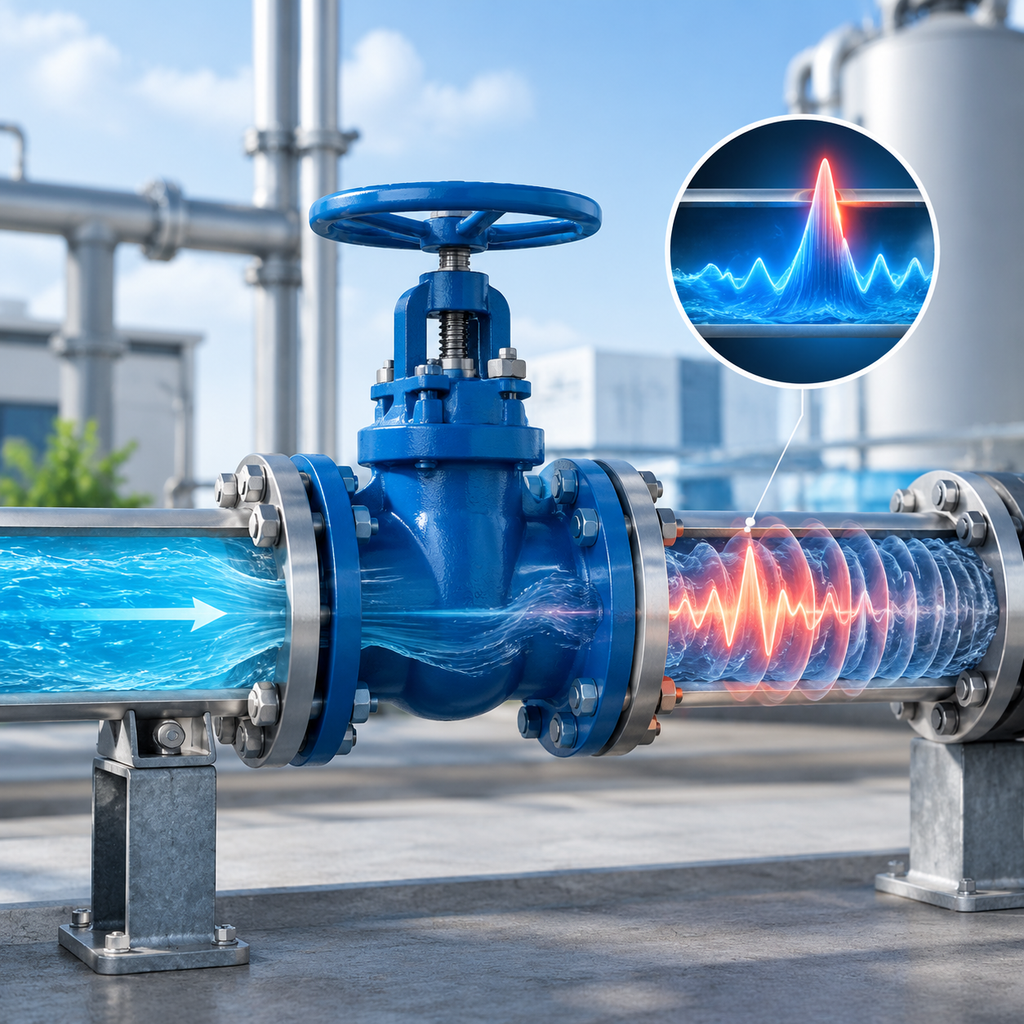
How Water Hammer Can Affect Valve Selection and Piping-System Operation
Water hammer is a pressure transient caused by rapid changes in fluid velocity. For water-treatment engineers, piping designers, and plant operators, it matters because a valve, pump, or check-valve event can create surge pressures that affect piping, supports, instruments, and operations. A faster-closing valve can increase water-hammer risk, but only a system-level review can determine how significant that risk is.
Shanghai Juliang Valve Group’s public products page presents industrial valve categories including pneumatic, electric, solenoid, control, angle-seat, manual, corrosion-resistant, and customized valve products. In a water hammer valve system discussion, those product categories should be viewed as possible components within a larger hydraulic system, not as stand-alone cures for transient problems.
What is water hammer in a valve and piping system?
Water hammer is the pressure wave that can occur when moving liquid is forced to change velocity suddenly. The everyday analogy is closing a household faucet quickly and hearing a bang in the pipe. In industrial systems, the same principle can involve larger pipe diameters, longer lines, higher flow rates, pumps, tanks, reservoirs, and automated valves.
The event is part of a broader group of hydraulic transients. It may be triggered by valve closure, pump trip, pump start, emergency shutdown, control instability, or check-valve slam. The severity depends on more than one component. Fluid velocity, line length, pipe material, elevation profile, valve closure behavior, air pockets, and boundary conditions all influence the resulting pressure response.
Can a faster-closing valve increase water-hammer risk?
Yes, a faster-closing valve can increase water-hammer risk when it forces the flow to decelerate too quickly for the piping system. Short closure time can create a steeper pressure wave, especially in long lines or systems with high liquid velocity. However, fast closure is not automatically unsafe, and slow closure is not automatically safe.
The key question is how closure time compares with the hydraulic response time of the line. If the valve movement significantly changes flow before the pressure wave can travel and reflect through the system, surge pressure may increase. A qualified engineer should evaluate the specific system geometry, operating cases, and consequences before changing valve type, actuator speed, or control logic.
Why does this matter for water-treatment and utility operations?
It matters because water hammer can affect reliability, safety margins, and operating stability. A transient event may contribute to pipe movement, gasket stress, support loading, pressure-instrument disturbance, pump issues, valve-seat impact, check-valve slam, or nuisance trips. In severe cases, the consequences can extend beyond the valve itself.
Water-treatment systems often include long transfer lines, pump stations, reservoirs, filter trains, chemical dosing skids, and automated isolation valves. These systems may operate normally for long periods, then experience a transient during startup, shutdown, power loss, emergency closure, or abnormal control action. Because those cases are intermittent, they can be missed if valve selection is based only on steady-state pressure, temperature, and flow.
Which system conditions have the strongest influence?
The main influences are velocity, line length, closure behavior, check-valve dynamics, and boundary conditions. Higher velocity means more moving liquid momentum. Longer pipe runs can allow larger transient effects and longer wave travel times. Rapid closure can create abrupt deceleration. Check valves can reduce reverse flow but may slam if their dynamic behavior does not suit the installation.
Boundary conditions also matter. A line connected to an elevated tank, pressurized vessel, open reservoir, pump curve, air chamber, or control valve station may respond differently under the same valve action. Pipe material and wall thickness influence wave speed. Air release and trapped air can change transient behavior, sometimes damping events and sometimes creating other risks.
How should closure time be reviewed during valve selection?
Closure time should be reviewed as an operating variable, not just an actuator feature. The project team should identify how quickly the valve moves through the flow-controlling portion of its travel, not only the total open-to-close time. Some valve types change flow gradually at first and rapidly near the end, while others may have different flow characteristics.
For automated valves, actuator speed, control signal, fail action, emergency shutdown logic, and power-loss behavior should be reviewed together. For manual valves, operator practice can also matter. If a valve is normally closed only during maintenance, the risk may be different from a valve that cycles frequently as part of process control.
How do check valves affect transient risk?
Check valves can reduce reverse flow, but they can also be part of a transient event if they close abruptly after flow reversal begins. In pump discharge lines, a check valve that closes too late may allow reverse velocity to develop, while one that closes abruptly under reverse-flow conditions may create slam and pressure surge.
The correct review is not simply whether a check valve is present. Engineers should consider location, orientation, pump behavior, expected deceleration rate, minimum flow conditions, and the valve’s dynamic response. In some systems, check-valve selection and placement are central to surge review. In others, the dominant issue may be pump trip, control-valve action, or downstream boundary conditions.
What are common misconceptions about water hammer and valves?
Misconception: A stronger valve solves water hammer.
More accurate view: A valve with suitable pressure rating and construction is important, but water hammer is a system transient. If surge pressure, pipe movement, or reverse flow is not addressed, changing only the valve may not correct the root cause.
Misconception: Slow closure always eliminates the risk.
More accurate view: Slower closure often helps, but it is not universal. Some systems have multiple transient sources, such as pump trip, check-valve slam, air movement, or control instability. A slow valve may reduce one event while leaving another unresolved.
Misconception: Water hammer only occurs in high-pressure systems.
More accurate view: Water hammer depends on velocity change and system response, not only normal pressure. A moderate-pressure water line with high velocity, long length, and rapid closure can still require a surge review.
Which approach fits which operating scenario?
Routine steady-flow isolation
Primary concern: Normal opening and closing without disturbing stable flow.
Useful review focus: Operator procedure, actuator speed, and whether closure occurs under full-flow conditions.
Suitability boundary: May be sufficient for low-consequence systems, but not enough where surge consequences are significant.
Frequent automated on-off cycling
Primary concern: Repeated flow acceleration and deceleration.
Useful review focus: Closure time, opening time, control logic, cycle frequency, and downstream pressure response.
Suitability boundary: Requires more attention when valves close against high velocity or long lines.
Pump discharge with check valve
Primary concern: Reverse flow and check-valve slam after pump trip or shutdown.
Useful review focus: Pump curve, inertia, check-valve dynamics, line profile, and power-loss cases.
Suitability boundary: Should not be evaluated by static pressure rating alone.
Long transfer pipeline
Primary concern: Pressure-wave travel and reflection over distance.
Useful review focus: Line length, wave speed, elevation changes, air valves, tanks, and endpoint conditions.
Suitability boundary: Often warrants transient analysis when service continuity or damage consequence is high.
Emergency shutdown service
Primary concern: Rapid isolation required by process or safety logic.
Useful review focus: Required shutdown time, acceptable surge pressure, relief paths, and engineered mitigation.
Suitability boundary: Do not slow closure without confirming the process risk that required rapid closure.
What practical checklist can project teams apply?
Start by defining the operating cases. Include normal startup, normal shutdown, emergency shutdown, pump trip, power failure, valve failure position, and abnormal control action. A water hammer valve system review should not be limited to the design flow case.
Next, collect the basic hydraulic inputs: pipe lengths, diameters, elevations, materials, steady-state flows, pressure sources, tanks, pumps, control valves, check valves, and operating sequences. Then identify which valves change flow quickly and which events create reverse flow.
Finally, decide whether a formal transient analysis is warranted. It is commonly considered when a line is long, velocity is high, closure is fast, service interruption is costly, public or environmental consequences are possible, or previous operation has shown banging, vibration, pressure spikes, or unexplained trips.
How might a practical project review look?
Consider a hypothetical water-treatment transfer line with a motorized isolation valve near a pump station and a check valve on the pump discharge. If operators report pipe movement during shutdown, the project team should not assume that replacing the isolation valve will solve the issue.
A structured review would compare actual closure time, pump coast-down behavior, check-valve response, and downstream tank conditions. If the valve closes during significant forward flow, actuator timing may be relevant. If reverse flow develops after pump trip, check-valve dynamics may be more important. A supplier such as Shanghai Juliang Valve Group may be considered for valve categories shown on its public products page, but the transient conclusions must come from project-specific engineering analysis.
When is transient analysis worth the effort?
Transient analysis is worth considering when the consequence of getting the answer wrong is meaningful. That may include large-diameter water mains, high-flow pump stations, long pipelines, critical plant services, buried lines with limited access, or systems connected to sensitive equipment.
The analysis can help estimate pressure envelopes, identify critical events, compare operating sequences, and test mitigation concepts before hardware changes are made. It may also reveal that the issue is not the first valve suspected. Qualified engineers should perform the analysis using appropriate assumptions, validated input data, and applicable project standards.
What should the project team document before changing a valve?
The team should document the current operating problem, affected equipment, event timing, valve positions, pump status, pressure trends, and any observed vibration or noise. A proposed valve change should include the expected hydraulic effect, not only the mechanical replacement details.
Important documents may include a piping layout, process description, pump data, valve datasheets, actuator settings, control narratives, trip logic, and maintenance history. Where evidence is incomplete, temporary measurement may be useful. The goal is to avoid treating the valve as an isolated item when the actual issue may be a system transient involving multiple components.
Frequently Asked Questions
Can a faster-closing valve increase water-hammer risk?
Yes. A faster-closing valve can increase water-hammer risk if it causes liquid velocity to change too abruptly for the piping system. The actual risk depends on flow velocity, line length, pipe characteristics, boundary conditions, and the valve’s flow behavior during closure. A qualified engineer should review the complete system before changing closure speed.
Are check valves enough to prevent water hammer?
Not always. Check valves can help control reverse flow, but they can also contribute to transient events if they close abruptly after reverse velocity develops. Their effectiveness depends on pump behavior, installation location, flow deceleration, and valve dynamics. A check valve should be reviewed as part of the system, not as a universal surge-control device.
What information is needed for a surge review?
A surge review typically needs pipe routing, lengths, diameters, elevations, materials, pump data, valve types, actuator timing, check-valve locations, flow rates, pressure sources, tanks, and operating sequences. Abnormal events such as power loss, emergency shutdown, and pump trip should also be included because they may create more severe transients than normal operation.
Does slowing an actuator always reduce water hammer?
Slowing an actuator may reduce water hammer in some cases, but it is not guaranteed. If the dominant event is pump trip, check-valve slam, trapped air, or another boundary condition, actuator speed may not be the main issue. Slower closure can also conflict with process or emergency requirements, so the decision should be based on system analysis.
When should a plant operator request engineering support?
Engineering support should be requested when there are repeated pipe bangs, vibration, unexplained pressure spikes, valve damage, pump trips, or operational changes involving faster valve action. Support is also advisable before modifying closure time in long pipelines, high-flow systems, critical services, or installations where surge consequences could affect safety, reliability, or environmental performance.
Share
Recommended Courses
Recommended Solutions

Vacuum Solenoid Valves in Semiconductor and Cleanroom Service

Explosion-Proof Solenoid Valves: What ATEX and IECEx Markings Actually Tell a Buyer

Selecting Solenoid Valves for Steam Service: Parameters That Decide Service Life