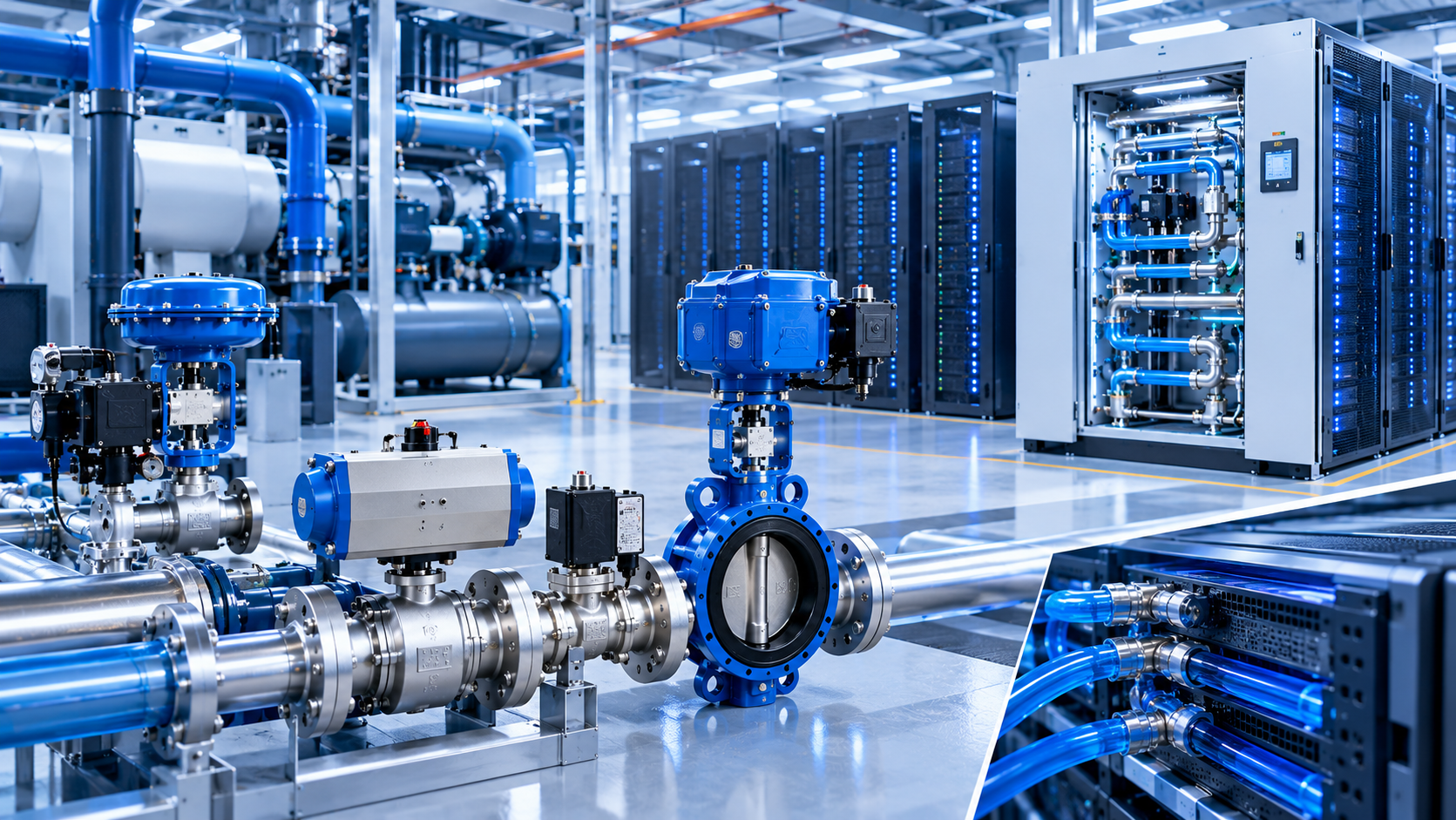
As data center computing density increases, cooling systems are evolving from conventional air cooling toward chilled-water, direct-to-chip and other liquid-cooling architectures. In these systems, valves are not simply pipeline isolation components. They help control coolant flow, isolate equipment, support redundancy, regulate pressure and temperature, and enable maintenance without unnecessarily interrupting the wider cooling network.
ASHRAE describes modern data center thermal systems as integrated networks involving pumps, valves, piping, heat exchangers, sensors and control systems. In liquid-cooled facilities, coolant distribution units (CDUs) can connect facility water systems with technology cooling systems serving IT equipment.
For engineers, MEP contractors and data center operators, understanding the role of industrial valves in these systems is increasingly important.
Quick Answer: Why Are Valves Important in Data Center Cooling?
Valves in data center cooling systems control and isolate chilled-water, condenser-water and technology-cooling circuits. Depending on the system architecture, they may regulate flow to cooling coils, isolate chillers or pumps, control bypass flow, connect redundant cooling paths, or manage coolant distribution around CDUs and liquid-cooled IT equipment.
The appropriate valve depends on the cooling medium, flow rate, pressure, temperature, pipe size, control strategy, required leakage performance and maintenance requirements.
In variable-flow systems, control valves work together with pumps and sensors. As cooling demand changes, valve position can change system flow and differential pressure, while variable-speed pumps adjust their operating point accordingly. ASHRAE describes this interaction as a key part of variable-flow chilled-water system design.
Why Is Data Center Cooling Different from Conventional HVAC?
Data centers operate continuously and can have highly concentrated thermal loads. The cooling system therefore has to manage not only temperature but also availability, redundancy, maintenance access and changing IT loads.
Traditional HVAC systems may primarily focus on maintaining room temperature and humidity. Data center cooling systems must additionally consider the consequences of cooling-system interruption.
Liquid cooling adds another layer. Instead of removing heat primarily through room air, coolant can be delivered much closer to the heat-generating electronic components.
ASHRAE identifies direct-to-chip cooling, immersion cooling, rear-door heat exchangers and CDUs among the technologies used in modern data center thermal systems.
This creates a more complex fluid-control network in which valves become part of the thermal-management architecture.
Where Are Industrial Valves Used in a Data Center?
A typical cooling infrastructure may contain several different valve locations.
At the chiller plant, valves can isolate chillers, pumps, heat exchangers and associated piping. In the distribution network, valves control or isolate branches supplying air-handling units, cooling coils or CDUs.
Within a CDU, valves may be involved in primary and secondary coolant circuits, bypass arrangements and flow-control functions. At the rack or equipment level, smaller valves can support isolation and coolant management for liquid-cooled equipment.
ASHRAE's data center guidance describes looped chilled-water distribution with sectional valves and valved branch connections, allowing portions of the system to be modified or serviced without requiring a complete system shutdown.
This makes valve arrangement an important part of maintainability as well as fluid control.
What Types of Valves Are Commonly Used?
Different cooling functions require different valve structures.
Butterfly valves are commonly considered for larger-diameter water pipelines because of their compact structure and relatively low installation space. They can be used for isolation and, depending on design and control requirements, flow regulation.
Ball valves can provide tight shut-off and are often used where compact isolation is required.
Control valves are used where coolant flow needs to be continuously modulated in response to temperature, pressure or flow conditions.
Check valves help limit reverse flow and can be relevant around pumps and parallel flow paths.
Solenoid valves can provide electrically controlled on/off switching in auxiliary circuits or automation systems.
Juliang's published product catalogue includes pneumatic valves, electric valves, control valves, solenoid valves, manual valves and other industrial valve categories, with water, wastewater, power generation and industrial manufacturing among its listed application areas.
How Do Control Valves Work in Variable-Flow Cooling?
A variable-flow cooling system adjusts coolant flow according to actual thermal demand.
When a cooling coil or terminal unit requires less cooling, its control valve can move toward the closed position. This changes the hydraulic resistance of the system. A differential-pressure sensor can detect the resulting pressure change, and the variable-speed pump can adjust its speed.
When demand increases, the control valve opens further and the pump can increase flow.
This relationship can be simplified as:
Cooling demand → valve position → system differential pressure → pump speed → coolant flow
ASHRAE notes that two-way automatic control valves are commonly used in variable-flow chilled-water systems, with pump speed adjusted through VFD control to maintain the required system pressure.
The valve therefore becomes part of a larger control loop rather than functioning as an independent component.
Why Is Minimum Flow Important?
Chillers and other cooling equipment may require a minimum flow rate to operate correctly.
If too many downstream valves close simultaneously, system flow can fall below the equipment's required minimum. This can create operational problems or cause protective shutdowns.
For this reason, bypass arrangements and appropriate control strategies may be used to maintain minimum equipment flow.
ASHRAE specifically discusses bypass control valves in variable-flow chilled-water systems and notes the need to maintain minimum chiller flow under low-load conditions.
Valve sizing therefore cannot be separated from the hydraulic design of the complete cooling system.
How Do Valves Support Data Center Redundancy?
Data center cooling systems commonly use redundant equipment and multiple flow paths so that individual components can be maintained or isolated.
Valves provide the isolation points that make these configurations practical.
For example, an operator may need to isolate one chiller, pump, CDU or branch circuit while keeping other cooling equipment in operation.
A looped distribution arrangement with sectional valves can provide greater flexibility than a simple single-path system. ASHRAE's data center guidance specifically describes sectional valves and branch valves as mechanisms that can support modification and maintenance without shutting down the entire distribution system.
The exact redundancy strategy remains project-specific and must be coordinated with the cooling plant, electrical system and data center availability requirements.
What Changes with Direct-to-Chip Liquid Cooling?
Direct-to-chip cooling brings coolant closer to the heat-generating components inside IT equipment.
Instead of relying exclusively on air to remove heat from the server environment, liquid can circulate through cold plates or related thermal interfaces.
ASHRAE identifies direct-to-chip systems as one of the major liquid-cooling approaches for high-power computing equipment and describes CDUs as interfaces between facility water systems and technology cooling systems.
This creates additional requirements for fluid distribution.
Engineers need to consider coolant chemistry, pressure, flow uniformity, leak detection, temperature control, connection design and maintenance procedures.
Valves used in these systems should therefore be evaluated as part of the complete coolant loop.
Why Is Water Quality Important?
Liquid-cooling systems can use different fluids, including chilled water, water with additives, glycol-based fluids, deionized water and other application-specific coolants.
The choice of coolant affects heat-transfer performance, corrosion risk, freezing behavior, microbial growth and material compatibility.
ASHRAE notes that coolant selection requires consideration of wetted-material compatibility, maintenance and operational requirements. It also notes that glycol-based fluids can reduce freezing risk but may reduce heat-transfer performance compared with water.
Valve materials and sealing materials must therefore be compatible with the actual coolant.
A valve suitable for ordinary HVAC water should not automatically be assumed suitable for every liquid-cooling application.
Why Does Condensation Matter?
Liquid cooling introduces another important thermal-management issue: condensation.
If coolant temperature falls below the surrounding air's dew point, moisture can form on cold surfaces.
This can create risks for electronic equipment.
ASHRAE's guidance on water-cooled servers emphasizes maintaining coolant temperature above the relevant dew-point condition and identifies proportional or binary control valves as possible mechanisms for controlling incoming water flow in certain non-CDU liquid-cooling configurations.
This means valve control can contribute to condensation management, but it must operate together with temperature sensors, controls and the overall thermal-management strategy.
How Should Data Center Cooling Valves Be Selected?
The selection process should begin with the cooling circuit rather than the valve name.
| Selection Factor | Engineering Question |
|---|---|
| Medium | What coolant is being used? |
| Temperature | What are normal and design supply/return temperatures? |
| Pressure | What are normal and maximum pressures? |
| Flow | What are minimum, normal and maximum flow rates? |
| Pipe Size | What is the nominal line size? |
| Function | Isolation, regulation, bypass or reverse-flow protection? |
| Actuation | Manual, pneumatic or electric? |
| Control | On/off, modulating or proportional? |
| Materials | Are body and seals compatible with the coolant? |
| Installation | Is the valve accessible for maintenance? |
| Redundancy | Does the valve need to isolate a redundant branch? |
| Monitoring | Is position feedback required? |
For control valves, additional information such as flow coefficient, differential pressure and control characteristic may be required.
Electric or Pneumatic Valves for Data Center Cooling?
Both electric and pneumatic actuation can be used in industrial cooling systems, but the choice depends on the facility architecture.
Electric actuators can integrate naturally with building-management and automation systems where electrical control infrastructure is already available.
Pneumatic actuators can provide fast actuation where compressed air is available and may be useful for certain industrial process environments.
For a data center project, engineers should evaluate response time, fail position, available utilities, control signal, feedback, environmental conditions and maintenance requirements rather than selecting an actuator based only on general preference.
Juliang publishes both electric and pneumatic valve families, including butterfly, ball and other configurations that can be considered for water and industrial fluid-control applications.
What Should Engineers Consider When Specifying a Valve for a Data Center?
The valve specification should describe the complete service condition.
For a chilled-water isolation valve, the specification may focus on pressure class, temperature, line size, connection, material, leakage and actuator requirements.
For a modulating control valve, the specification may additionally require flow coefficient, differential pressure, control signal and actuator sizing.
For liquid-cooling systems serving high-density computing, engineers may need to provide more detailed coolant information and define requirements for cleanliness, leak detection and maintenance access.
A concise technical RFQ might therefore connect:
Cooling load → coolant → flow → pressure → temperature → valve function → actuator → control system
This approach reduces the risk of choosing a valve based only on nominal pipe size.
What Maintenance Issues Can Affect Cooling Valves?
Valve maintenance is important because a cooling system may operate continuously for long periods.
Potential issues include seal degradation, actuator problems, corrosion, incorrect positioning, debris accumulation and loss of feedback signals.
Valves that remain in one position for extended periods may also require planned exercising or inspection depending on the design and system requirements.
ASHRAE's data center guidance recommends considering valve exercise and maintenance as part of chilled-water system operation.
Maintenance planning should also consider whether an individual valve can be serviced without compromising cooling availability.
Shanghai Juliang Valve Group and Data Center Fluid Control
Shanghai Juliang Valve Group's public product catalogue includes electric valves, pneumatic valves, control valves, solenoid valves and other industrial valve categories, while its application filters include power generation, water and wastewater, industrial manufacturing and related fluid-control sectors.
For data center cooling projects, the relevant technical evaluation should focus on the actual cooling circuit. Valve type, body and sealing materials, pressure-temperature conditions, flow requirements, actuator configuration and control interface should be confirmed against the project specification.
The same evidence-based approach used for industrial HVAC and process-fluid systems can be applied to data center cooling: define the service first, then select the valve configuration that matches the hydraulic and control requirements.
FAQ: Industrial Valves for Data Center Cooling
What valves are used in data center cooling systems?
Depending on the system, data centers can use butterfly valves, ball valves, control valves, check valves and solenoid valves for isolation, regulation, reverse-flow protection and automated control.
Are valves important in liquid-cooled data centers?
Yes. Liquid-cooling systems contain pumps, piping, heat exchangers, CDUs and control components, and valves help manage flow paths, isolation and regulation.
Can butterfly valves be used for chilled-water systems?
Butterfly valves can be considered for suitable chilled-water isolation and flow-control applications, particularly in larger pipelines. The exact application depends on valve design, pressure, temperature, flow and control requirements.
Why are control valves important in variable-flow cooling?
Control valves change flow according to cooling demand. Their operation interacts with differential-pressure sensing and variable-speed pumps in many variable-flow systems.
What is a CDU in a liquid-cooled data center?
A CDU, or coolant distribution unit, provides an interface between facility cooling water and the technology cooling system. It can contain heat exchange, pumping, valves, sensors and temperature-control functions.
What information should be provided when purchasing cooling-system valves?
At minimum, engineers should provide the coolant, pressure, temperature, flow, pipe size, valve function, materials, actuation and control requirements. More demanding applications may require additional information about redundancy, cleanliness, leak detection and coolant chemistry.
Conclusion
Industrial valves are an important part of modern data center cooling infrastructure. Their role extends from basic isolation to variable-flow control, equipment protection, redundancy management and integration with automated cooling systems.
As high-density computing increases the adoption of liquid cooling, valve selection needs to consider the entire thermal-management system rather than the valve alone. Coolant properties, flow distribution, pressure, temperature, minimum equipment flow, redundancy and control strategy all influence the final configuration.
For engineers and data center infrastructure teams, a process-based specification provides a clearer foundation for evaluating valve solutions and integrating them into reliable cooling systems.
Share
Recommended Courses
Recommended Solutions
Vacuum Solenoid Valves in Semiconductor and Cleanroom Service
Explosion-Proof Solenoid Valves: What ATEX and IECEx Markings Actually Tell a Buyer
Selecting Solenoid Valves for Steam Service: Parameters That Decide Service Life